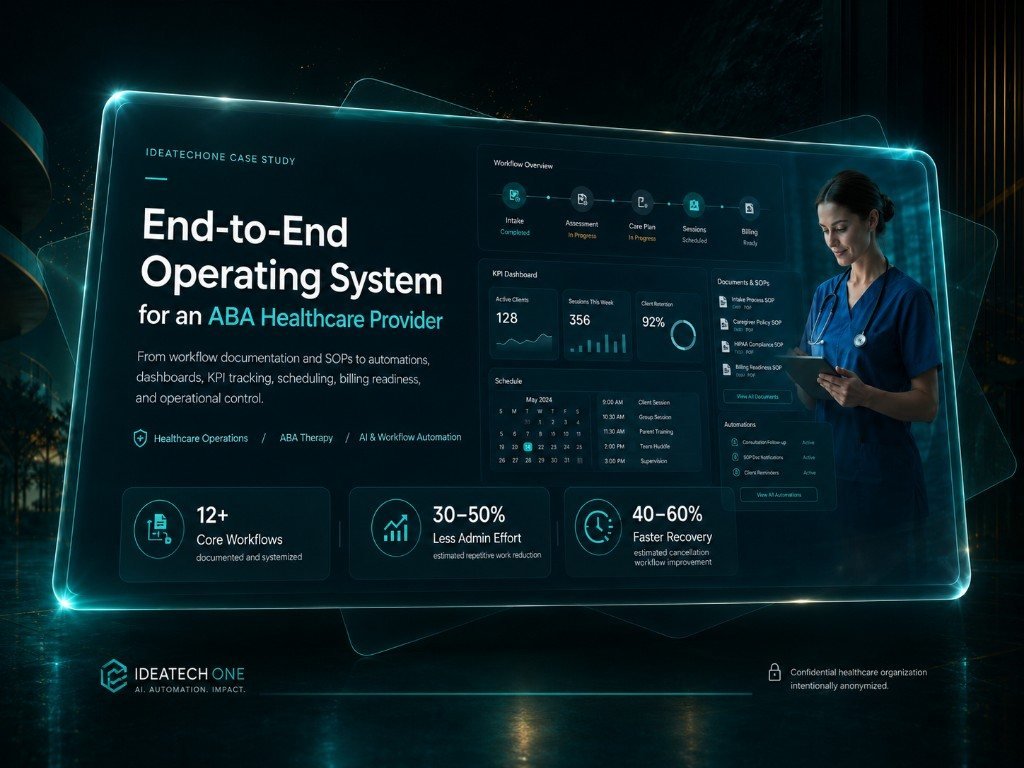
End-to-End Operating System for an ABA Healthcare Provider
From workflow documentation and SOPs to automations, dashboards, KPI tracking, scheduling, billing readiness, and operational control.
Key Outcomes
The project transformed fragmented operational work into a documented, measurable, and automation-ready healthcare operating system across clinical and administrative workflows.
- End-to-end operating system connecting intake through billing and reporting.
- 12+ core workflows documented with ownership, SOPs, and success measures.
- 30-50% estimated reduction in repetitive administrative work.
- 40-60% faster cancellation recovery through matching and coordination automation.
- Real-time KPI visibility for leadership, operations, clinical, and billing teams.
Percentage outcomes are operational estimates based on the implemented workflow scope. Replace them with measured client analytics when validated production data is available.
Confidentiality note: The healthcare organization is intentionally anonymized. This case study focuses on the operating model, systems, workflows, and measurable business value without exposing client-identifying information.
Quick Facts
- Project Type
- Healthcare operations system, ABA workflow automation, SOPs, KPI dashboards, and operational reporting
- Industry
- ABA therapy, behavioral health, and healthcare operations
- Client
- Confidential healthcare / ABA provider
- Platform Type
- Internal operating system supporting clinical, administrative, scheduling, and billing teams
- Primary Users
- Operations managers, clinical directors, BCBAs, RBTs, scheduling staff, billing staff, administrators, and leadership
- Core Focus
- Workflow documentation, SOP standardization, automation, authorization tracking, scheduling, cancellation recovery, documentation compliance, billing readiness, and KPI visibility
- Automation Stack
- n8n, Zapier, APIs, webhooks, scheduled jobs, workflow triggers, reminders, notifications, and custom business logic
- AI Assistance
- Classification, summarization, data extraction, priority detection, exception triage, report drafting, and workflow routing
- Core Modules
- Intake, authorizations, scheduling, cancellations, staff utilization, notes, billing readiness, family communication, credentials, SOP library, dashboards, and KPI reporting
- Delivery Model
- Operational discovery, process mapping, SOP creation, system implementation, validation, rollout, and iterative optimization
Core Operating Principle
Every authorized hour is time-sensitive. If therapy is authorized but not scheduled, delivered, documented, and billed correctly, the provider risks both missed care and lost revenue. The operating system was designed to make those gaps visible early enough to act.
Background
ABA providers operate where clinical care, scheduling, insurance authorizations, documentation, staffing, billing, and family communication must work together every day. A delay in one area often creates downstream problems in several others.
A child may be approved for therapy hours, but if those hours are not scheduled, delivered, documented, and prepared for billing, the organization loses revenue and the child misses care that was already authorized. The operational cost is often invisible because it appears as slightly lower utilization, delayed billing, incomplete schedules, or repeated administrative follow-up rather than one obvious system failure.
The organization needed more than another dashboard, spreadsheet, or reminder tool. It needed an end-to-end operating system that documented how work should happen, assigned ownership, automated repetitive tasks, surfaced exceptions, and gave each team a clear view of what required attention.
Questions the system needed to answer
- Are authorized therapy hours being scheduled and delivered?
- Which clients are underutilized and at risk of losing hours?
- Which clinicians are available, credentialed, and within capacity?
- Which cancellations can still be recovered?
- Which notes are missing, late, incomplete, or blocking billing?
- Which completed sessions are ready for billing?
- Where are operational bottlenecks forming?
- What requires action today, and who owns the next step?
The Challenge
The provider faced interdependent operational bottlenecks across multiple teams and systems.
- Workflows lived in people, not in a shared operating model, processes were understood by experienced staff but not documented as clear, repeatable SOPs, creating dependency and making training, delegation, and continuity difficult.
- Scheduling and cancellation recovery were time-sensitive and manual, staff had a limited window to recover cancelled hours by checking availability, credentials, capacity, compatibility, and authorization rules across spreadsheets, calendars, and messages.
- Limited visibility into authorized vs delivered hours, leadership needed a connected view of authorized, scheduled, delivered, cancelled, recovered, and unrecovered hours, plus utilization and revenue at risk.
- Documentation gaps delayed billing readiness, missing, late, incomplete, or unsigned notes required repeated manual follow-up before sessions could move into billing.
- Repetitive admin work consumed skilled staff time, status checks, reminders, spreadsheet updates, reports, and daily task lists were largely rule-based and suitable for automation.
- Leadership lacked a shared KPI view, each team saw only part of the operation; leadership needed consolidated visibility into utilization, recovery, compliance, billing, capacity, and exceptions.
- Existing tools were disconnected, data lived across scheduling systems, clinical records, forms, email, and spreadsheets; employees acted as the integration layer.
- Automation needed safeguards, healthcare workflows require human review for clinical judgment, approvals, exceptions, compliance-sensitive actions, and family communication.
Operational reality: An authorized therapy hour is perishable. If it is not delivered within the required window, it cannot always be recovered later.
The Solution
A four-layer operating system connecting SOPs, automation, operational controls, and KPI visibility.
Layer 1 — Workflow and SOP foundation
We documented the provider's operating model, clarified ownership, standardized handoffs, and created repeatable SOPs for the most important clinical and administrative processes.
Layer 2 — Automation and orchestration
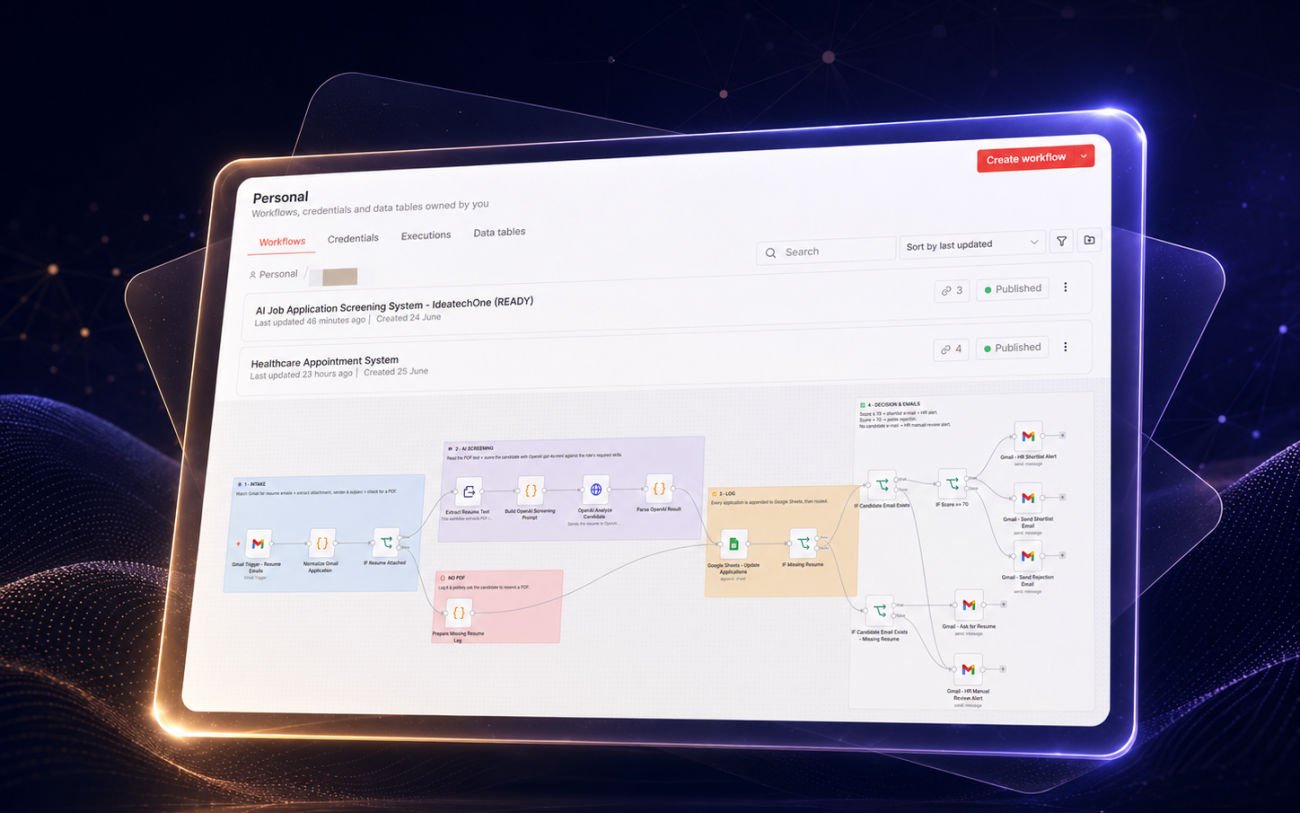
n8n, Zapier, APIs, webhooks, scheduled triggers, notifications, and custom logic automated repetitive work, routed information, created tasks, sent reminders, escalated overdue items, and synchronized operational data.
Layer 3 — Operational systems
Structured workflows for intake, authorizations, scheduling, cancellation recovery, staff utilization, clinical documentation, billing readiness, family communication, and credential tracking.
Layer 4 — Dashboards and KPI management
Role-specific dashboards gave leadership, operations, clinical teams, and billing staff real-time visibility into performance, exceptions, risks, and next actions.
Core Modules
- Workflow Documentation & SOP Library, purpose, ownership, inputs, tools, decision points, exceptions, escalations, outputs, and KPIs for each core workflow.
- Client Intake & Onboarding, referral through eligibility, authorization, care-team assignment, and first-session confirmation.
- Authorization Tracking, approved, consumed, and remaining hours, renewal deadlines, underutilization alerts, and authorization gaps.
- Scheduling & Staff Utilization, availability, capacity, open slots, supervision constraints, and schedule changes.
- Cancellation Recovery Automation, capture cancellation → eligibility and capacity checks → matching options → notification → acceptance → schedule update → family confirmation → recovered-hour reporting.
- Clinical Notes & Documentation Tracking, missing, late, incomplete, and unsigned notes with reminders and escalation before billing blocks.
- Billing Readiness Workflow, attendance, note completion, signatures, review, and approval before a session moves to billing.
- Family Communication, templated onboarding, confirmations, cancellation updates, and follow-ups with human approval for sensitive messages.
- Staff Credential & Compliance Tracking, expirations, training, supervision requirements, and assignment eligibility.
- KPI Dashboards & Operational Control, utilization, cancellation performance, documentation status, billing readiness, staffing, intake, authorization risk, and revenue leakage indicators.
AI-assisted support inside controlled workflows
- Classify requests, notes, and operational exceptions.
- Extract structured data from forms, emails, or unstructured text.
- Summarize daily activity, exception queues, and leadership reports.
- Prioritize tasks by urgency and business rules.
- Draft routine messages while keeping approval for sensitive communication.
- Route cases to the correct team based on intent, status, and policy.
System design principle: Automate routine coordination, surface exceptions early, keep humans responsible for judgment, and make every critical workflow measurable.
Implementation Process
- Operational discovery, reviewed real workflows across intake, authorizations, scheduling, cancellations, staff assignment, documentation, billing preparation, family communication, reporting, and leadership review.
- Workflow mapping, documented triggers, owners, required data, tools, decisions, manual steps, exceptions, escalations, outputs, and KPI impact.
- SOP creation, converted maps into clear SOPs with purpose, ownership, step-by-step instructions, tools, expected output, escalation paths, and success measures.
- Automation scoring, prioritized by frequency, time spent, error risk, business importance, complexity, judgment required, data availability, and expected ROI.
- System integration, connected scheduling, forms, communication, CRM/operational records, spreadsheets, and reporting sources via n8n, Zapier, APIs, webhooks, and custom logic.
- Automation development, built reminders, status updates, task creation, notifications, follow-ups, dashboard updates, exception alerts, data sync, AI-assisted summaries, and escalations.
- Dashboard and KPI setup, role-specific views for leadership, operations, clinical teams, and billing.
- Testing and validation, intake, authorization changes, cancellations, replacement scheduling, missing notes, billing exceptions, overdue tasks, notifications, and dashboard accuracy.
- Rollout and optimization, phased introduction, SOP-based training, production monitoring, and rule refinement.
Representative automation flows
- New client intake, form submitted → validate → create onboarding record → assign owner → notify intake team → schedule follow-up → update dashboard.
- Authorization expiry risk, renewal threshold → calculate remaining time and utilization → create renewal task → notify owner → escalate if idle → update risk dashboard.
- Cancellation recovery, cancellation received → check client, authorization, staffing, credentials, and capacity → generate options → confirm replacement → update schedule and family → record recovered hours.
- Missing clinical note, completed session without note → grace period → notify clinician → create follow-up → escalate → mark billing block → clear when complete.
- Billing readiness, session completed → attendance verified → notes and signatures validated → mark ready or route exception → update billing dashboard.
- Leadership summary, scheduled KPI run → collect utilization, cancellations, notes, billing, authorizations, and staffing → summarize risks → send leadership report.
Results
A more structured, visible, and automation-ready operation across the full service-delivery lifecycle, an operational foundation rather than a collection of isolated automations.
Business Impact
- Reduced repetitive administrative work and manual status checking.
- Improved cancellation response speed and recovery visibility.
- Created a single operational view of authorized, scheduled, delivered, cancelled, and recovered hours.
- Made missing documentation and billing blockers visible before they became month-end surprises.
- Standardized onboarding, scheduling, follow-up, and escalation through clear SOPs.
- Reduced dependency on individual employees holding undocumented process knowledge.
- Gave managers real-time visibility into risks, workloads, delays, and ownership.
- Allowed clinical and operational staff to focus more on high-value decisions and care delivery.
The operating system enabled the provider to manage
- Client intake and onboarding
- Insurance authorization tracking
- Scheduling and clinician assignment
- Cancellation recovery
- Staff capacity and utilization
- Clinical notes and documentation compliance
- Billing readiness and exception handling
- Family communication
- Staff credentials and compliance
- SOPs and workflow ownership
- Dashboards and KPI management
- Automated reminders, alerts, and escalation
- Leadership reporting and operational review
Final positioning: This was not simply a software implementation. It was an operational transformation that created better structure, automation, accountability, and visibility across daily ABA service delivery.
Need an operating system for healthcare operations?
IdeaTechOne designs and implements end-to-end healthcare operating systems, SOPs, workflow automation, dashboards, and KPI control, so your teams spend less time on repetitive coordination and more time on care delivery.
Book a Free Call